
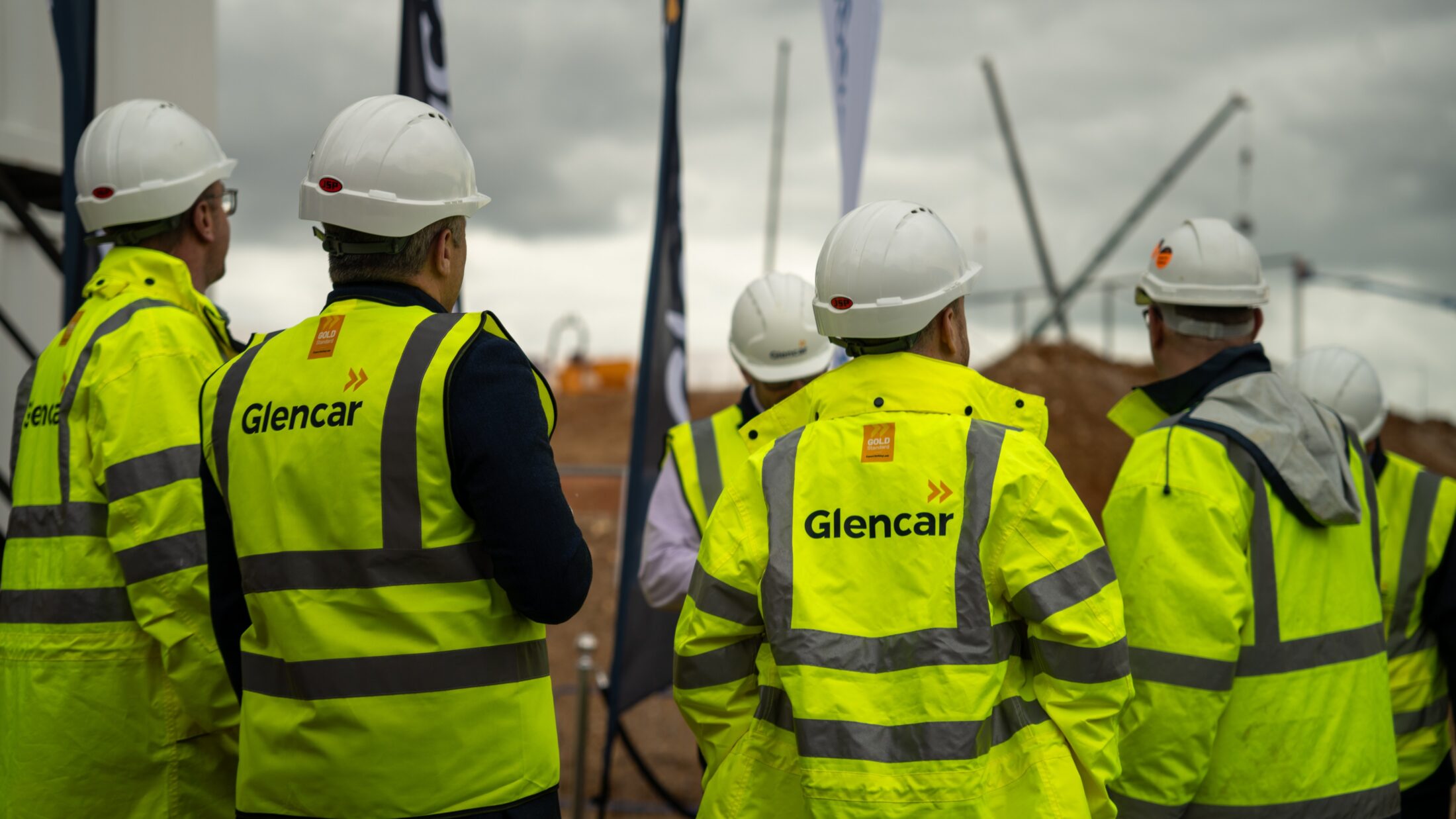
Glencar is a privately owned contractor, founded in 2016 and headquartered in St Albans. Employing more than 350 people, with offices across the UK and Ireland, the company delivers a diverse range of new build, fit-out, refurbishment and civil engineering projects.
Glencar has become one of the UK’s leading privately owned contractors. Operating across industrial, logistics, life sciences, data centres and commercial office projects, and with more than 80% of its work coming from returning customers, turnover has rocketed to around £500 million.
The challenges
- Complex projects – with a large number of subcontractors and specialised trades – meant a high volume of payment applications.
- Manual administration of payment applications would occasionally mean emails or spreadsheets were missed, risking breached deadlines.
- The time-consuming aspect of manual payment processing meant a heightened risk of internal inefficiencies and supply chain disputes.
During continued growth, the team at Glencar recognised that manual payment application processes were becoming increasingly inefficient.
Daniel Forde, Quantity Surveyor at Glencar, explained, “By the time I’d dug out emails, done evaluations on the payment notice, and had the discussions with the subcontractors, it could take me a week or so to go through the whole payment process.”
Chloe O’Sullivan, Assistant Quantity Surveyor, also commented, “Subcontractors issued their valuations to us via email. However, when colleagues were absent for any period of time or really busy, these risked being missed.”
Adding to this, Finance Director, Tom Tutty, said, “All applications for payment were managed by our commercial teams and the finance team wasn’t really getting visibility, which was obviously causing issues in terms of forecasting cash and understanding our true liabilities. There was a lot of back-and-forth between the departments, correcting errors and chasing approvals. This meant delays for month-end reporting, time spent answering subcontractor enquiries about application status, and caused general inefficiencies around the business.”
Watch the case study video:
The solution
- Digitised the application for payment process using Payapps, ensuring compliant and transparent financial information and enhancing supply chain collaboration.
- Standardised payment application templates, driving significant accuracy benefits through the removal of manual spreadsheet processing and eliminating inconsistent formats.
- Improved visibility across commercial and finance teams, with applications, approvals and payment status available in one central location.
- Direct support of Glencar’s users and their subcontractors through set-up and beyond.
To support its continued growth in Ireland and potentially other new countries, and to standardise its payment application process, Glencar implemented Payapps, replacing manual spreadsheets and email workflows with a single digital platform.
Tom said, “To scale a business, you need a repeatable process on every site and Payapps provides that. It’s a consistent process that every member of the commercial and finance team follows, and every subcontractor follows. This ‘copy-and-paste’ formula provides control and reliability around reporting and forecasting accuracy, and gives confidence to all our stakeholders.”
Commercial and finance teams have gained real-time visibility of applications, while subcontractors have benefited from a consistent, transparent submission process.
Chloe commented, “We use it throughout the valuation cycle and to easily keep track of variations. From an admin point of view, it’s made life a lot easier and everyone has a central point to log into, subcontractors included.”
Indeed collaboration and communication between Glencar and its supply chain have been strengthened and the need to deal with application for payment enquiries has been removed.
Ben Buchanan, Commercial Director, explained, “The subcontractors can log onto the system, see at what point their application is, and what’s been certified. All the breakdowns are in there. The introduction of Payapps has made it a more transparent and attractive environment for supply chain partners to work with us.”
Ben continued, “A typical reservation about implementing any system is the time it takes to educate the users and roll it out to a level of efficient operation, but the Payapps team shouldered the load which meant a quick and smooth integration of the system within our business.”
In terms of the support received during and since the integration, Chloe said, “There were online guides that we could refer to and the live chat system has been fantastic, not only for ourselves but for the subcontractors that Payapps supports directly.”
The results
- Reduced payment processing from as much as one or two weeks each month to just one or two days, freeing commercial teams to focus on higher-value work.
- Enhanced supply chain collaboration and transparency, giving subcontractors real-time visibility of application status and increased confidence around payment.
- Strengthened reporting, forecasting and risk management, allowing teams to identify issues earlier and manage contractual risk more effectively.
- Created a consistent, repeatable payment process across projects, supporting Glencar’s continued growth and making it easier to scale.
Easy support access and payment applications administration

One of the clearest benefits for Glencar has been the amount of time saved across the payment process, locating emails, carrying out valuations, preparing payment notices and discussing assessments with subcontractors. With Payapps, the same process can now often be completed in as little as a day.
Daniel revealed, “Having everything in one place streamlines the whole process and means we can issue payment notices a lot quicker. Before Payapps, it could take a week or so to go through the whole payment process. Now we can often complete it in a day. That time saving has allowed us to focus on other facets of the job, like forecasting and procurement.”
The benefits extend beyond efficiency alone. As Tom explained, “Freeing commercial teams from administrative tasks means they can spend more time on site, developing professionally and building relationships with the supply chain – areas that ultimately contribute more directly to project delivery and business performance.”
Greater visibility, control and confidence
Bringing the payment process into one central platform has given Glencar much greater visibility across commercial and finance teams. Applications for payment can be seen by finance as soon as they are submitted, allowing the business to forecast cash from an earlier point and model different scenarios with greater confidence.
Instead of relying on back-and-forth communication, manual corrections and chasing approvals, teams can now see outstanding actions and potential issues in one place and address them earlier. This increased transparency helps remove pinch points while providing greater control over reporting and forecasting.
Terry Glyn, Commercial Manager, commented, “Payapps allows everyone to work to a time scale, and ensures we’re hitting our dates on time. And the earlier we have visibility of everything, the earlier we can react on it and understand what our risk profile looks like.”
Tom added to that saying, “Finance now has visibility of applications for payment the moment they land. That allows us to forecast cash much earlier and model both worst case and reasonable case scenarios.”
For newer team members, the structured workflow also makes the payment cycle easier to understand. Chloe highlighted how each stage is clearly set out, supported by notifications and a central view of where each valuation sits within the process. Glencar has consequently seen significantly fewer late payment notifications.
A repeatable process that supports growth
For Glencar, consistency is particularly important as the business grows. Payapps provides a repeatable process that can be applied across projects, with subcontractors, commercial teams and finance all working within the same approach. As Tom noted, this makes it easier to scale without introducing different processes from one project to another.
Centralised information also gives management a clearer view of performance across the business – from identifying subcontractors that submit late to seeing which commercial teams complete approvals promptly and where deadlines may be slipping. “That insight enables Glencar to manage contractual risk more proactively while maintaining a consistent approach as the company expands,” said Tom.
The result is a process that is not only more efficient, but more robust and transparent for everyone involved. As Ben put it, the introduction of Payapps has created “a more transparent and attractive environment for supply chain partners to work with us,” while the additional governance and tiered approvals provide a more controlled process internally.
As a final thought, Tom remarked, “I’d recommend Payapps – it’s been really good for Glencar. It’s saved the commercial teams a lot of time, improved the visibility for finance and, as we grow, has helped us manage risk across the business.”
Are you ready to build a consistent payment process?
Discover how Payapps can empower your team to save time, enhance accuracy, and improve subcontractor relationships. Book a demo today to see Payapps in action.