
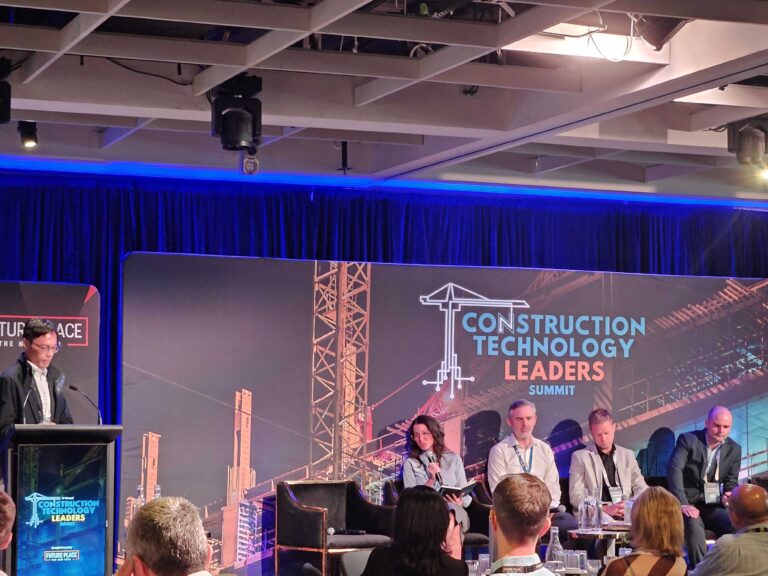
At the 2026 Construction Technology Leaders Summit, Payapps’ Misty Cronin challenged construction leaders to look beyond internal efficiency and consider how technology can improve collaboration across the entire supply chain.
Construction businesses are investing in more technology than ever, yet disconnected systems, manual hand-offs and inconsistent information continue to create challenges across project delivery.
According to Infrastructure Australia’s 2025 Infrastructure Market Capacity Report, 64% of surveyed building and construction firms had invested in data and digitalisation over the preceding 12 months.
But investment alone does not guarantee better construction collaboration. The real opportunity lies in connecting people, processes and information in ways that benefit everyone involved in delivering a project.
That was a central message from Misty Cronin, Head of Sales ANZ at Payapps, an Autodesk Company, who joined industry leaders at the Construction Technology Leaders Summit on 29 October 2026.
Speaking on the panel Creating the Bridge: How Supply Chain Integration and Workflow Automation Drives Project Delivery Success, Misty brought her extensive commercial payments experience to a discussion spanning digital transformation, project delivery, workflow automation and supply chain integration.
Her message was clear: successful digital transformation should make collaboration easier for both main contractors and subcontractors, not simply improve processes within one organisation
Construction Collaboration Must Work for Both Sides
Construction projects rely on complex relationships between main contractors, subcontractors, consultants and suppliers. Yet technology decisions are often made primarily around the requirements of the organisation purchasing the software.
For subcontractors working across multiple projects, this can mean adapting to different systems, submission requirements and administrative processes for each builder.
Misty challenged the industry to reconsider this approach.
“If you’re trying to solve a two-party process with a one-sided view … you’re going to fall short.”
Drawing on her career in commercial payments, Misty explained that technology must deliver meaningful value to both parties in a commercial relationship.
For main contractors, that means greater consistency, visibility and control. For subcontractors, it means simpler processes, less duplication and clearer information about what has been submitted and assessed.
This is particularly relevant to progress claims, where both parties are involved in the same commercial process but may be working from different information and systems.
A successful digital workflow should bring those parties together rather than simply transferring administrative responsibility from one to the other.
How Construction Workflow Automation Reduces Manual Hand-offs
Another recurring theme was the challenge of connecting information across the construction technology ecosystem.
Most construction businesses already use multiple systems to manage project delivery, financial reporting, document control and commercial administration.
While each platform may perform its intended function, information often needs to be transferred manually between them.
Misty highlighted the importance of eliminating those unnecessary hand-offs.
“You don’t want to leave people in the process to be the integration layer.”
Progress claim management offers a practical example.
A subcontractor submits a claim, the commercial team assesses it, adjustments may be made, approvals are recorded and the agreed amount needs to reach the relevant financial systems.
When these steps rely on separate spreadsheets, emails and manual data entry, teams can spend unnecessary time checking, reconciling and transferring information.
Purpose-built technology can help connect those workflows.
Payapps enables main contractors and subcontractors to manage progress claim submissions, assessments and approvals through a shared digital process. Its construction ERP and accounting integrations also help approved claim information flow into existing financial systems, reducing duplicate handling.
The objective is not necessarily to replace every system in a contractor’s technology stack. It is to ensure accurate information moves between the right systems and people with minimal friction.
Why Transparency Matters for Construction Collaboration
While automation can improve productivity, Misty emphasised that transparency is equally important in strengthening commercial relationships.
“Transparency is much more than just knowing the status.”
In progress claim management, meaningful transparency involves both parties working from consistent contract information, understanding assessment changes and having access to clear records of decisions.
For example, when a subcontractor submits a claim, both parties benefit from being able to see the original submission, supporting documentation, assessment adjustments and reasons for any differences.
This creates greater clarity over what has occurred throughout the process.
Technology cannot eliminate construction disputes. Commercial disagreements about valuations, variations and contractual obligations will still arise.
However, a more transparent process can reduce avoidable confusion caused by disconnected spreadsheets, missing documentation and inconsistent records.
These principles sit at the heart of smarter progress claim management: creating a more structured, visible and consistent experience for both main contractors and subcontractors.
They also demonstrate why construction collaboration should extend beyond traditional project management activities to include the commercial processes that connect businesses throughout project delivery.
Better Digital Workflows Can Unlock More Than Efficiency
The panel also explored how effective automation can create opportunities beyond the immediate task being improved.
Misty argued that when businesses establish structured, trusted workflows, their teams can redirect time previously spent on routine administration towards activities that create additional value.
Early Payment was one example she discussed.
Once progress claim processes are consistent and trusted, main contractors may be better positioned to introduce optional payment arrangements that support subcontractor cash flow.
Payapps’ Early Payment feature allows eligible subcontractors to request payment on approved progress claims before the normal contractual payment date, subject to the main contractor’s defined eligibility, timeframes and discount arrangements.
For main contractors, requests are managed through the existing progress claim workflow rather than separate emails or informal processes.
For subcontractors, it provides an additional option for managing cash flow.
The broader point is that improving a core commercial workflow can create opportunities for innovation without introducing unnecessary complexity.
Raising the Standard of Supply Chain Integration
As the discussion concluded, the panellists encouraged construction leaders to focus on the outcomes they want to achieve before deciding which technologies to implement.
The consensus was that automation is most valuable when it supports a well-designed process, reduces rework and makes it easier for people to perform their roles.
Misty extended that thinking to the wider construction supply chain.
She encouraged project leaders to consider whether their technology choices make subcontractors and suppliers better off, rather than measuring success solely through internal productivity gains.
That requires a broader view of digital transformation.
Instead of asking only how a new platform will make internal teams more efficient, construction businesses should also consider whether it:
- Reduces unnecessary administrative work for subcontractors.
- Improves consistency and transparency across projects.
- Makes information easier to share between commercial and finance teams.
- Creates a clearer record of decisions and responsibilities.
- Strengthens the working relationship between main contractors and their supply chain.
These are practical measures of successful construction collaboration.
And while no single platform can solve every challenge across a complex project, connected commercial workflows can make an important contribution.
Connected Construction Starts with Better Commercial Workflows
The Construction Technology Leaders Summit reinforced an important message for the industry: adding more technology does not automatically create better project outcomes.
Greater value comes from selecting technology that connects people, simplifies existing processes and improves the way businesses collaborate.
For Payapps, this means recognising that progress claim management is not simply an internal administrative task. It is a shared commercial process that directly affects both main contractors and subcontractors.
By making that process more consistent, transparent and connected, businesses can reduce unnecessary friction and create a stronger foundation for commercial collaboration.
Because connected construction isn’t just about bringing systems together. It’s about making it easier for everyone involved in delivering a project to work together.
Discover how Payapps helps standardise progress claim management.
About Misty Cronin
Misty Cronin is Head of Sales ANZ at Payapps, an Autodesk company. With extensive experience in commercial payments across multiple industries, Misty brings a practical perspective to improving payment workflows, commercial transparency and collaboration between main contractors and subcontractors.