
Most construction disputes don’t arrive suddenly.
They leave clues.
The challenge is that those clues often look like everyday issues — easy to ignore, easy to push down the road, especially when teams are under pressure.
But when these small gaps start to stack up, they usually point to something bigger forming beneath the surface.
If you’re managing progress claims, here are five warning signs worth paying attention to.
1. Claims Don’t Align to the Contract Structure
When progress claims don’t clearly map back to the agreed contract breakdown, everything becomes harder.
Assessments take longer. Reconciliation becomes manual. And reasons for difference become difficult to explain.
It might feel like an admin issue — but it’s often where disputes begin.
2. Variations Sit Unresolved Across Multiple Claims
Variations are rarely the problem. Silence is.
When variation requests aren’t responded to early — even just to acknowledge them — assumptions start to fill the gap. And those assumptions rarely align.
By the time the variation is addressed, positions have already started to harden.
3. Reasons for Difference Are Vague or High-Level
Phrases like “amount not agreed” or “insufficient detail” might feel efficient.
But they create ambiguity. And under Security of Payment legislation, vague responses can quickly become a risk — especially if they don’t clearly address what was claimed.
Clarity isn’t just good practice. It’s protection.
4. Retention Balances Are Hard to Explain
Retention issues don’t always trigger immediate disputes. But they do erode trust over time.
If retention amounts can’t be clearly tracked, explained, or reconciled at any point in the project lifecycle, they often become a problem later — usually when projects are closing out.
5. Payment Schedules Are Prepared Under Pressure
Payment schedules are one of the highest-risk points in the process.
Tight deadlines, multiple claims, and manual workflows create the perfect conditions for mistakes — whether it’s timing, documentation, or method of service.
And under SOPA or CCA, those mistakes can have immediate consequences.

47%
of Quantity Surveyors and Contract Administrators have 6 or more disputes with subcontractors per week regarding progress claims.¹

87%
of Quantity Surveyors and Contract Administrators report that variations are significantly easier to manage when handled through a structured digital workflow such as Payapps.¹

53%
of finance professionals in construction believe it is difficult to meet their deadlines to ensure payment terms comply with SOPA or CCA legislation.²
These Issues Rarely Exist in Isolation
Individually, none of these feel like major problems. But together, they form a pattern.
And that pattern is often the early stage of a dispute. The reality is, most teams don’t have a knowledge problem. They know what good practice looks like.
The challenge is applying it consistently — especially under pressure.
Want to Pressure-Test Your Process?
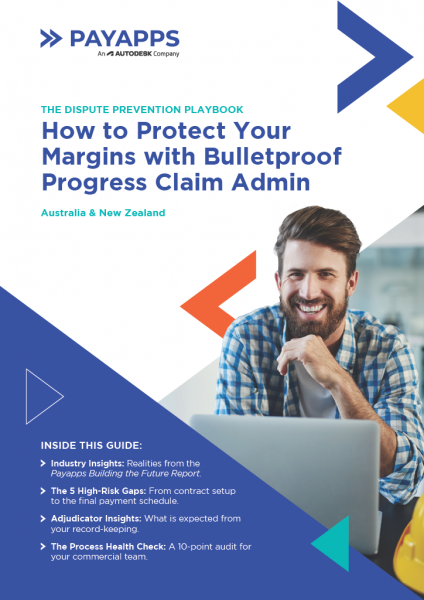
If you’re seeing any of these warning signs in your projects, it’s worth taking a closer look at your progress claim workflow before they escalate. We’ve pulled together a practical guide to help commercial teams identify and address these risks early.
Inside, you’ll find:
- The 5 high-risk gaps across progress claims
- What adjudicators expect from your documentation
- A 10-point checklist to assess your current process