5 Warning Signs Your Progress Claim Process Is Heading for a Dispute
Spot the early warning signs of progress claim disputes. Learn how variations, payment schedules, and documentation gaps create risk in construction projects.
Far East Consortium (FEC) is a Hong Kong-based luxury developer that has been operating in Australia for more than 30 years. In 2022, the business launched its construction arm in Western Australia.
With the move into construction came the need for greater rigour around subcontractor management and compliance, particularly in relation to state-based security of payment legislation.
In 2023, Project Director Andrew White was appointed to lead the establishment of FEC Constructions’ Queensland operations. In doing so, he inherited the progress claims process that had been implemented when the Perth office was first established.
Like many construction businesses, the process relied heavily on spreadsheets to track claim and contract data. Subcontractors submitted monthly claims in varying formats, while compliance documentation was often out of date or missed entirely. Claim data — including retention and variations — was then copied and reconciled across spreadsheets, as well as into a payment schedule sent back to subcontractors.
The process was further complicated by the requirement for multiple signatories to approve each claim. As one of three final approvers, Andrew quickly identified this as the biggest bottleneck, with the added risk of missing payment deadlines under security of payment legislation.
The fast-paced nature and high value of FEC Constructions’ construction projects increased their complexity and highlighted the need for a system that could keep pace. With up to 500 concurrent monthly contracts projected across multiple projects, Andrew recognised it would be near impossible to manually review each spreadsheet for accuracy. From the outset, it was critical to reduce the risk of human error.
While the process was technically working, it was slow, drawn out, and carried clear compliance risk. Andrew could see several areas that would benefit from greater efficiency. He also knew that implementing the right solution early would allow FEC Queensland to scale faster, remain competitive in the market, and avoid the need to hire additional staff to manage growing administrative demands.
Building a strong operational foundation for FEC Constructions from day one was a priority. As a new construction business entering a competitive market, it was critical to adopt industry-leading systems early, rather than retrofitting processes later.
Two considerations guided the evaluation. First, the business needed an operationally compliant solution that could automate what had become a lengthy, manual progress claims process. Second, the cost–benefit needed to be clear and justifiable so Head Office in Hong Kong could have confidence in both the governance controls and the additional investment.
Another member of the FEC team, Commercial Manager Cameron Beck, had been introduced to Payapps in a previous role. As Andrew and Cameron explored ways to automate progress claims, they recognised that Payapps’ contract-driven workflows — including automated approval requests and tracking of retention and variations — aligned closely with the controls and oversight FEC Constructions needed.
Andrew explains:
“When it came to progress claims, we asked ourselves if we wanted to automate the process; yes or no. And when the answer was yes, the decision was Payapps. No question about it.”
Payapps’ dashboard also stood out during the evaluation process, offering clear visibility across new, outstanding and at-risk claims. Users could easily see what needed to be actioned to avoid security of payment penalties, as well as identify out-of-date subcontractor documentation. This visibility was seen as a way to reduce administrative burden and allow commercial teams to focus on managing projects rather than reconciling data.
Securing buy-in from Head Office in Hong Kong followed naturally. Once the business risks of manual processes were understood — including the potential cost of SoPA non-compliance, lost time, and the need to hire additional headcount to manage claims — the case for Payapps was clear.
Andrew shares:
“Once we explained the financial cost and risk of SoPA non-compliance, lost time and paying for additional headcount just to manage the claims process, plus the benefit of using tools like Payapps to attract the highest calibre subcontractors, they were quickly in agreement. Payapps just made sense.”
Payapps also appealed because it allowed FEC Constructions to onboard in-flight projects with dedicated support from the Payapps Customer Success team, without disrupting commercial or project teams.
Many of FEC’s subcontractors were already familiar with Payapps, which reduced onboarding effort and enabled them to start preparing, submitting and tracking claims with confidence. Importantly, the ability to include mandatory compliance documentation at the point of claim submission was seen as a major advantage — saving subcontractors time and reducing the need for contract administrators to chase missing information.

The approach has proven successful for FEC Constructions. Having completed the original projects using Payapps, Andrew and his team are now onboarding new projects and preparing to open a Victorian office — all of which will be run entirely through Payapps. The platform has enabled the business to expand without adding costly headcount or increasing the administrative burden on project and contract teams.
A key outcome has been the automation of the most time-consuming and risk-prone elements of the progress claims process. With Payapps in place, FEC Queensland can now set up contracts faster using a standardised breakdown, manage mandatory compliance documentation more effectively, and clearly identify claims that require action to avoid payment delays. Variations and retention are automatically calculated and reconciled against previously approved claims, reducing the risk of errors and rework.
Andrew believes the value of Payapps lies in its end-to-end workflows and the way it supports collaboration between FEC Constructions and its subcontractors.
For Andrew, the impact goes beyond efficiency. It’s about setting the right standard as the business grows.
“If you want to be a tier 1 builder working with tier 1 subcontractors, you need tier 1 systems in place, and Payapps is one of them.”

Spot the early warning signs of progress claim disputes. Learn how variations, payment schedules, and documentation gaps create risk in construction projects.

Disputes over payments to subcontractors don’t start at adjudication. Learn how progress claims, variations, and payment schedules create risk — and how to stop disputes early.

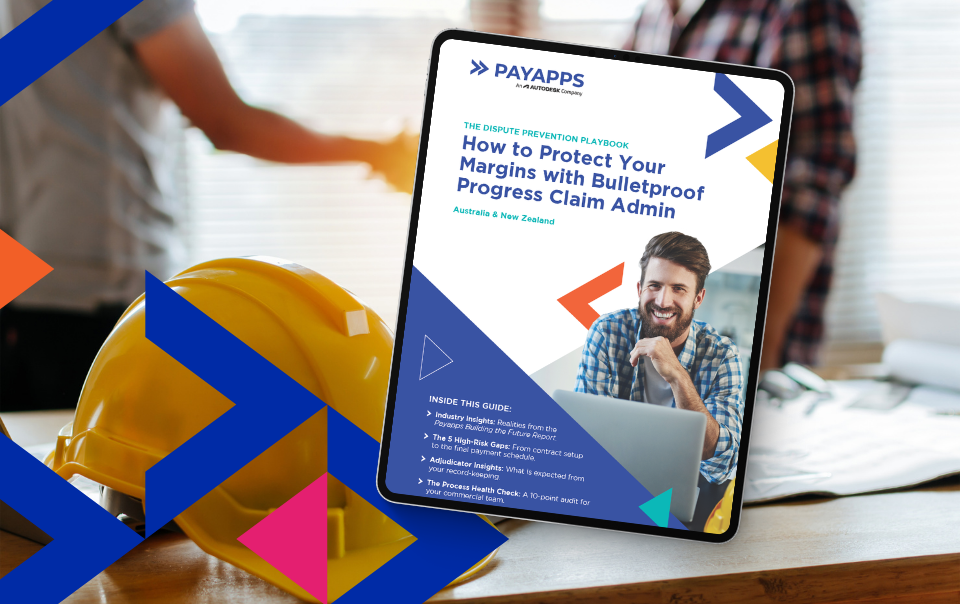
Construction disputes aren’t born; they’re built. Download our latest guide to identify the “clues” disputes leave behind and stop the snowball before it starts.